
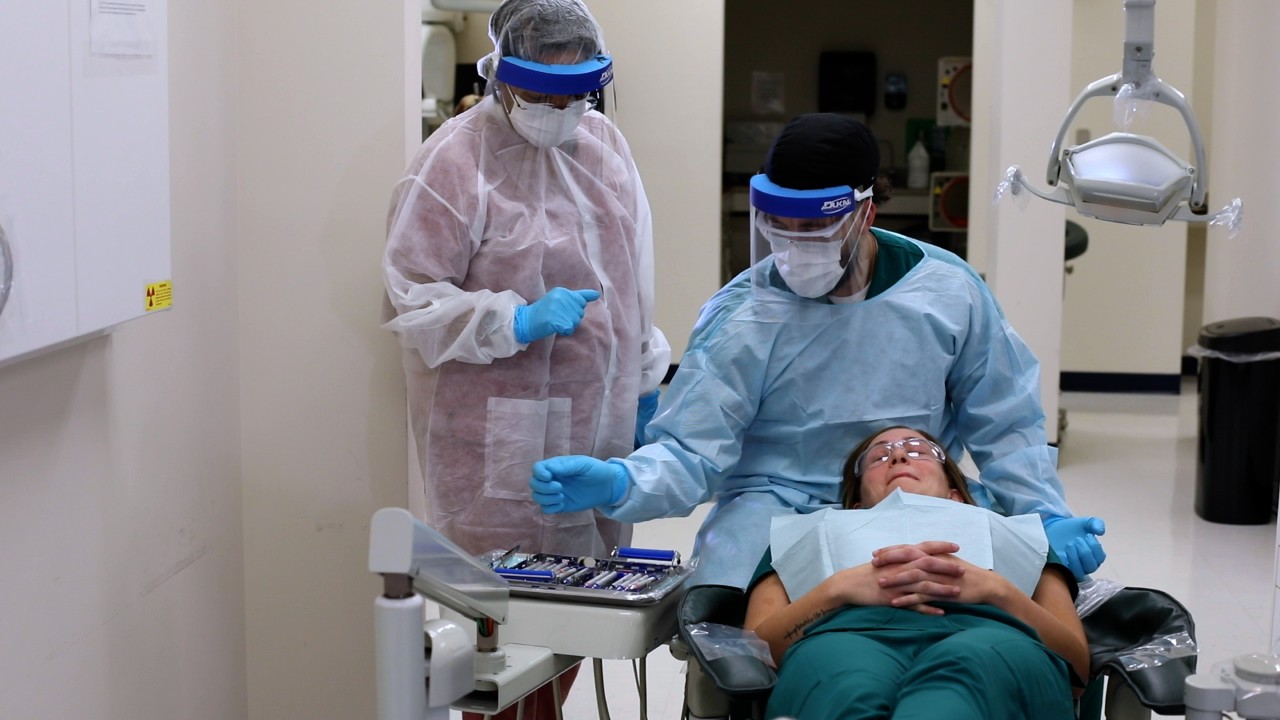
Oral diseases are among the most common chronic conditions in the United States. About 1 in 5 adults have untreated tooth decay, according to the Centers for Disease Control and Prevention (CDC), and more than 40% suffer from gum disease. Other conditions, like tooth loss and oral cancer, affect millions more.
Because oral health is such a crucial aspect of overall health — with links to cardiovascular disease, pneumonia, and even certain cancers — proper dental hygiene is key to good health. Consequently, dental professionals are in demand across the country. Dental assistants and dental hygienists are particularly sought-after for their pivotal role in preventive care and patient education.
For those looking to enter this field, understanding the differences between dental assistant vs. dental hygienist roles is an important initial step. Learning about these positions’ distinct functions in dental care, the training and credentials required, and the employment outlook for each can help aspiring professionals decide which career path is right for them.
What Does a Dental Assistant Do?
Dental assistants wear many hats in dental practices, where they act as patient liaisons and office administrators while also providing vital chair-side support to dentists. Their common day-to-day duties include:
Sterilizing instruments
Prepping patients for procedures
Managing patients’ records
Handling appointments and billing
Each state regulates what dental assistants can do. Dental assistants working in Atlanta — or anywhere in Georgia — can perform all of the above tasks as well as a host of others, including:
Applying topical anesthetic
Assisting in the placement/removal of temporary crowns and bridges
Handling post-treatment cleanup (e.g., removing sutures or periodontal dressing)
Polishing tooth enamel
Taking X-rays of patients’ teeth (with additional training)
Dental assistants can only carry out their clinical duties under the supervision of a dentist.
Expanded duty dental assistants (EDDA) have additional responsibilities, such as overseeing nitrous oxide/oxygen use during procedures, administering fluoride, and applying sealant to patients’ teeth.
Requirements to Become a Dental Assistant in Atlanta
Although Georgia does not have specific educational requirements for entry-level dental assistants, appropriate training is necessary to perform even the most basic duties. To take on more advanced responsibilities like coronal polishing or radiography, dental assistants need specialized training. They also must be CPR-certified to monitor patients under general anesthesia.
Additionally, to become an EDDA in the state of Georgia, dental assistants need to meet the following criteria:
Hold a high school diploma or equivalent credential
Complete a formal dental assisting training program
Hold a dental assistant certification
Georgia does not require licensure for dental assistants.
What Does a Dental Hygienist Do?
Dental hygienists also serve in a support role in dental practices, but they have more advanced, clinically focused responsibilities than dental assistants.
Dental hygienists in Atlanta can perform all of the same duties as dental assistants, including EDDAs, plus the following:
Cleaning patients’ teeth using various instruments, including scalers and ultrasonic tools
Examining patients’ teeth and gums to evaluate their oral health, and reporting findings to dentists
Administering medication/protective solutions to treat patients’ teeth and gums
Providing oral hygiene education to patients
Similar to dental assistants, the scope of practice for dental hygienists is determined by each state, so their specific responsibilities may vary.
Requirements to Become a Dental Hygienist in Atlanta
Unlike dental assistants, dental hygienists must be licensed, regardless of where they work. Licensing requirements for dental hygienists vary by state. Eligibility requirements for a dental hygienist license in Atlanta include the following:
Graduate from an accredited dental hygiene training program (typically an associate degree program)
Pass the National Dental Hygiene exam, administered by the Joint Commission on National Dental Examinations, and the Central Regional Dental Testing Service clinical exam
Pass a jurisprudence exam, which covers the laws and rules governing the practice of dental hygiene in Georgia
Complete a criminal background check
Licensed dental hygienists in Georgia need to complete a minimum of 22 hours of continuing education every two years to maintain their license.
Differences Between a Dental Assistant and a Dental Hygienist
A detailed understanding of the distinctions between dental assistants and dental hygienists can help aspiring professionals choose the right career path. Beyond their job descriptions, assistants and hygienists differ in terms of their training, the skills required for their jobs, and their employment prospects.
Scope of Practice
While both dental assistants and dental hygienists must work under the supervision of a licensed dentist, dental hygienists have a broader scope of practice and are allowed to perform a wider range of clinical duties than dental assistants. Hygienists can also provide oral health education to patients.
Training
Because dental hygienists take on more advanced responsibilities, they typically undergo more extensive clinical training than dental assistants. A dental assisting program curriculum may include a brief externship in a dental practice, whereas a hygienist program typically includes multiple clinical rotations.
This difference in scope means that dental hygienist training often takes longer to complete. At Fortis College in Smyrna, Georgia, the dental assisting program can be completed in just under a year on a full-time schedule. The dental hygiene program typically takes full-time students about three years to complete.
Skills
Dental assistants and dental hygienists rely on a similar skill set, though hygienists often possess a higher degree of technical expertise due to their advanced training. Given their important role in patient care, both assistants and hygienists should have strong interpersonal skills as well as a keen eye for detail and organizational abilities.
Other areas where they need proficiency:
Dental assistant skill areas: Exam room preparation, chair-side support, radiology, record management
Dental hygienist skill areas: Oral hygiene procedures (coronal polishing, scaling, and root planing), sealant application, administration of local anesthesia
Employment Outlook
Growing awareness of the link between oral health and overall health, combined with the increasing dental needs of an aging population, is driving demand for dental professionals nationwide. The U.S. Bureau of Labor Statistics (BLS) projects robust employment growth for both dental assistants and dental hygienists over the next several years:
Dental assistants, nationally: 8% growth from 2023 to 2033 (31,500 net new jobs)
Dental hygienists, nationally: 9% growth from 2023 to 2033 (19,600 net new jobs)
In Georgia, the job outlook is even brighter. Projections Central, a Department of Labor-sponsored site that provides state-level employment data, forecasts the following employment growth:
Dental assistants, Georgia: 11% growth from 2022 to 2032
Dental hygienists, Georgia: 11% growth from 2022 to 2032
Chart Your Career Path With Fortis
Choosing to pursue a dental assistant or a dental hygienist career requires a careful examination of the respective roles and the responsibilities, training, and employment outlook for each. Both of these types of professionals are vital contributors to patient care and benefit from strong job prospects.
Fortis offers both dental assisting and dental hygiene training at its Smyrna, Georgia, campus, located just outside Atlanta. The programs balance classroom instruction with experiential learning, enabling students to hone the interpersonal skills and technical expertise they need to enter this growing field.
Learn how Fortis can help you launch your career in dentistry.
Recommended Readings
A Day in the Life of a Dental Assistant: Job Description and Responsibilities
How to Become a Dental Hygienist
What Does a Pediatric Dental Assistant Do?