
Key Takeaways
Commercial and residential buildings rely HVAC professionals to maintain air-conditioning systems, avoiding the threat of high temperatures.
New Jersey HVAC jobs are expected to grow 7.4% by 2032, which is faster than the national average, according to Projections Central.
New Jersey has three levels of state HVAC licensure: apprenticeship, journeyperson, and master.
Climate change is affecting temperatures around the world, but may disproportionately affect New Jersey. A 2024 report from the Rutgers Climate and Energy Institute noted that New Jersey’s average annual temperature has warmed about four degrees since 1900, about 1.1 times faster than the rest of the globe. The report suggests these temperature changes will likely lead to more extreme weather events, including hotter summers.
To help combat the health threats of dangerously high heat, commercial and residential buildings will rely heavily on air-conditioning systems to help keep indoor temperatures cool.
To ensure that contractors meet the state requirements to work on heating, ventilating, and air-conditioning (HVAC) systems, they must be licensed. Obtaining an NJ HVAC license requires fulfilling certain education and work experience standards and passing a state exam. Completing an HVAC training program can help individuals meet the education requirements to qualify for licensure in this rewarding, in-demand field.
Benefits of an HVAC License in New Jersey
Obtaining a New Jersey HVAC license is the only way to qualify to perform installations, maintenance checks, and repairs on HVAC systems anywhere in the state, making it a required step in this skilled trades career. Additionally, holding an HVAC-R (heating, ventilation, air conditioning, and refrigeration) master license is the only way for New Jersey professionals to qualify to bid on contracts from the government, businesses, and residential owners as independent entrepreneurs.
An HVAC-R master license opens up the opportunity to work with a more varied pool of clients, which can increase a business’s success.
While New Jersey does license professionals at the apprentice and journeyperson levels, which permits them to perform a limited capacity of HVAC work, these are not standalone licenses.
Obtaining a New Jersey HVAC license can lead to a career in a field with significant job growth potential. According to data from Projections Central, positions for HVAC mechanics and installers in New Jersey are predicted to increase 7.4% between 2022 and 2032. This is much higher than the 4% job growth projected for all occupations between 2023 and 2033 by the U.S. Bureau of Labor Statistics (BLS).
The BLS suggests positive growth for this occupation will be in large part due to continued construction in need of HVAC system installations and maintenance.
New Jersey HVAC License Requirements
Individuals can choose from four options to meet the education and hands-on experience requirements to qualify for a master HVAC-R license. Apprentice and journeyperson are not standalone licenses, but instead act as steps toward obtaining a master HVAC license.
Below are the four choices, including how long each path takes:
Complete a minimum of four years of apprenticeship and one year of journeyperson experience
Earn a four-year bachelor’s degree in HVAC-R and complete one year of journeyperson experience alongside a master-level contractor
Earn a four-year bachelor’s degree in a field related to HVAC-R and complete three years of journeyperson experience alongside a master-level contractor
Complete a qualified trade school program, two years of apprenticeship, and one year of journeyperson experience alongside a master-level contractor
Apprenticeship
Holding an apprenticeship while enrolled in a qualified trade school program creates an integrated learning experience. For example, students with apprenticeships can continue to earn a paycheck from their HVAC position while also gaining comprehensive hands-on experience. Additionally, they’ll gain real-world training from experienced professionals, which can help develop their technical skills and industry knowledge.
Future HVAC technicians can only obtain an apprentice license after they have turned 18 years old and earned a high school diploma or a certificate of high school equivalency earned by passing the General Education Development test. Apprenticeship also requires a valid driver’s license and passing a background check.
Individuals who meet these criteria must find a currently licensed HVAC contractor who is willing to take them on as an apprentice, and then apply for the HVAC apprenticeship program managed by the New Jersey Department of Labor and Workforce Development (DOL).
Prospective technicians must submit an apprenticeship application that shows their proof of age, education level, and existing work experience. After being approved by the New Jersey DOL, an apprenticeship agreement must be signed by the employer and a DOL representative.
Apprenticeships typically take four years to complete, but requirements for master level licensure are less when combined with a degree or completion of a trade school program.
Journeyperson Experience
To become a journeyperson HVAC technician in New Jersey, which qualifies a person to work independently on HVAC systems, technicians must be at least 21 years old and be able to meet the physical demands of the job. Technicians need to obtain liability insurance and register with New Jersey.
Additionally, technicians need to have completed a minimum four-year HVAC apprenticeship or gained alternate HVAC experience through a training program or bachelor’s degree program. Experience gained as a journeyperson does not start until technicians have met these requirements, so work experience above the minimum as an apprentice does not count toward journeyperson hours.
Master HVAC-R Licensure
After meeting one of the four education and experience options, technicians can apply to take the New Jersey HVAC-R license exam. The exam covers both business and law alongside technical knowledge of electrical, HVAC, and refrigeration systems. After passing with a minimum 70% score, technicians can apply to the state board for licensure.
How to Apply for an HVAC License in New Jersey
Applying for an HVAC license in New Jersey is simple, requiring an online application and a $100 fee. If the application is approved, an additional $160 is required.
Technicians must include work citations signed by their supervising HVAC contractors, W-2s showing their time both as an apprentice and as a journeyperson, and their college or trade school transcript with their application. They also must prove that they have up to $500,000 of liability insurance and a $3,000 surety bond.
NJ HVAC licenses are valid for two years, expiring on June 30 every even-numbered year. Each renewal follows the same process, and each requires a $160 renewal fee. HVAC contractors also must complete a minimum of five hours of continuous education prior to each renewal.
Further Your Career as an HVAC Contractor
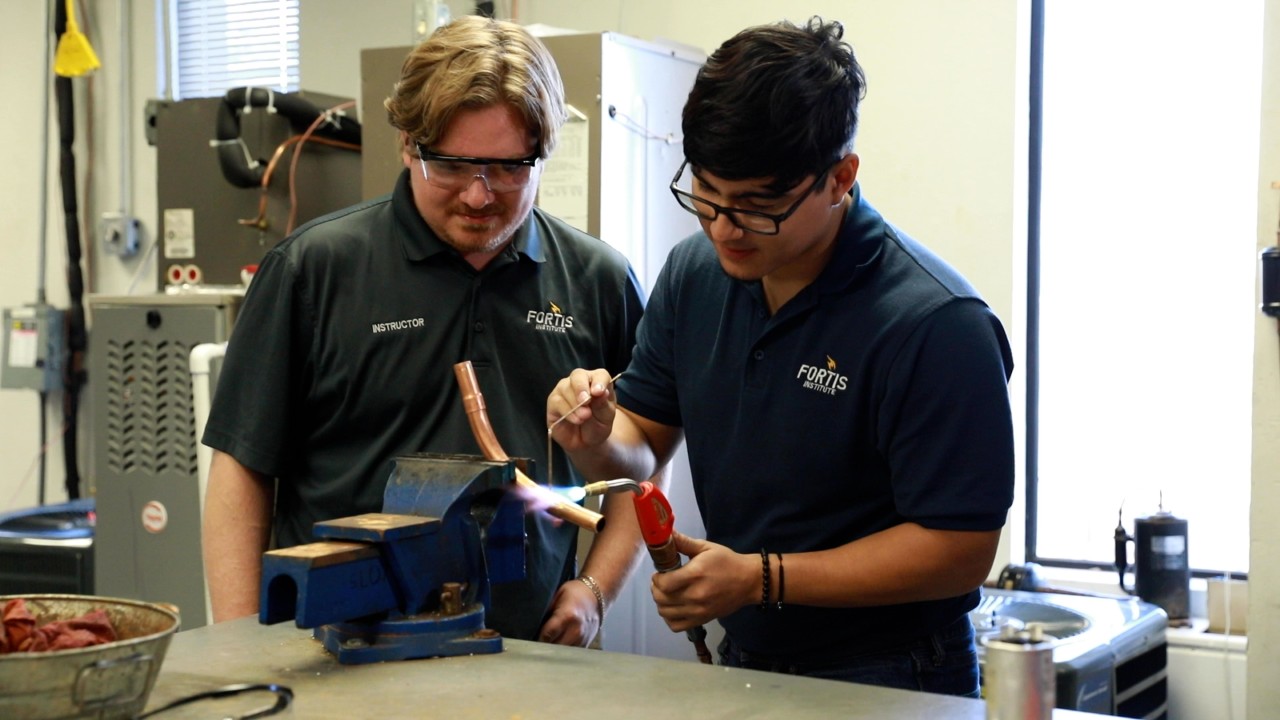
Obtaining your NJ HVAC license requires meeting specific educational requirements. Consider the benefits of enrolling in the Fortis HVAC-R training program at either our Wayne or Lawrenceville, New Jersey campus.
Using a combination of hands-on lab work and a curriculum that covers HVAC fundamentals, refrigeration systems, and green technology and energy efficiency, our program can prepare you for a career as an independent HVAC contractor with a master license.
The program also can help prepare you for the Environmental Protection Agency (EPA) Section 608 HVAC certification, a federal requirement to work with refrigerants.
Our 54-week program can get you ready to take on an apprenticeship with a strong foundation in the fundamentals of the field. Take the first step today toward a career in HVAC with Fortis.
Recommended Readings
How to Become an HVAC Contractor
HVAC Technician: Job Description, Requirements, and Outlook
What I Like Best About Working in HVAC