
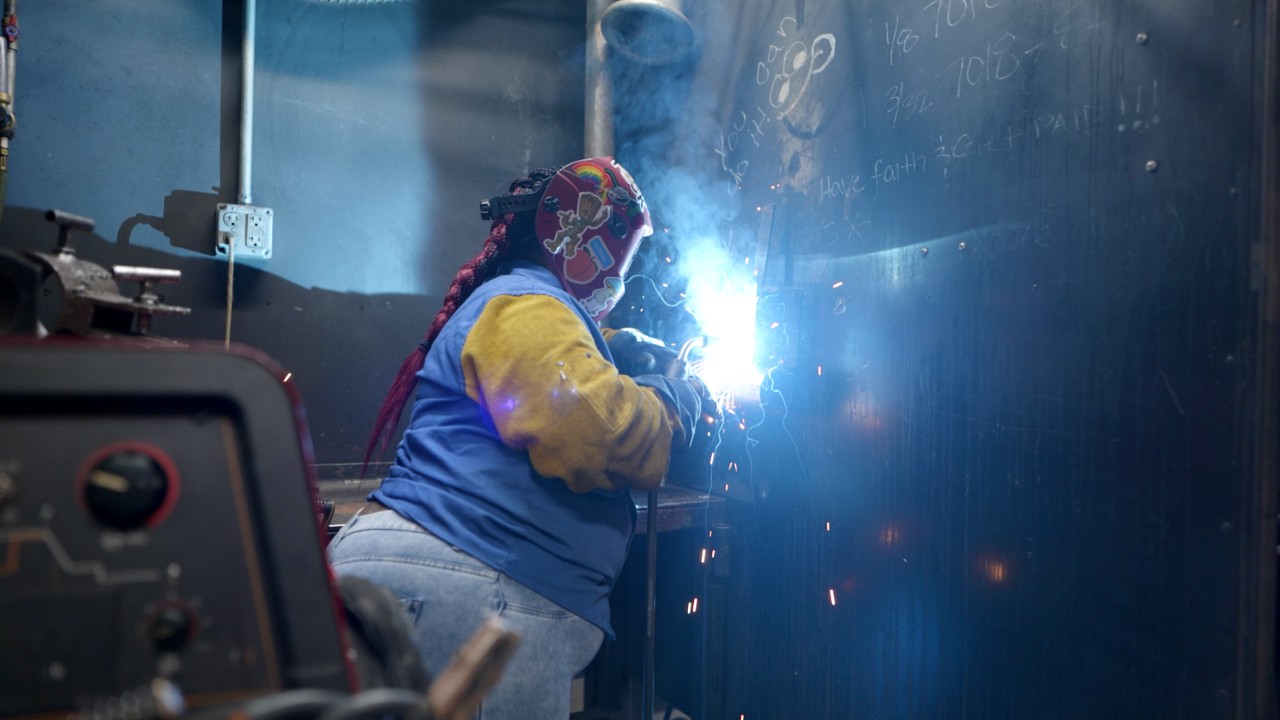
With tens of thousands of U.S. welders approaching retirement and billions of dollars being funneled into public- and private-sector construction and manufacturing projects, skilled welders are needed nationwide — particularly in Midwestern states like Ohio, where a booming manufacturing sector is fueling steady demand.
With campuses in Cincinnati and Cuyahoga Falls, Fortis College’s Ohio welding schools give aspiring welders access to diverse employment opportunities in a fast-growing trade.
Benefits of Going to Welding School in Ohio
One of the best ways to gain the necessary technical expertise for a welding career is through a welding training program. Enrolling in one of Fortis’ welding programs in Ohio positions students in the heart of one of the nation’s top markets for skilled trades workers.
The following are among the many benefits of pursuing a welding education in Ohio.
Focused Curriculum
Welding training programs prioritize career-centric instruction, omitting much of the general knowledge and liberal arts coursework provided in conventional college degree programs. By embracing a streamlined curriculum, students can complete their training and launch their career much faster than with a traditional degree program.
Hands-On Training
Fortis’ welding programs emphasize hands-on training, allowing students to hone practical technical skills while developing their critical thinking and problem-solving abilities. Much of this training occurs in real-world scenarios where students get to work with the same equipment professional welders use, providing them with valuable field experience and setting them up for success in the workforce.
Strong Job Market
Ohio has a favorable job market for aspiring welders. Construction and manufacturing are major drivers of the state’s economy — manufacturing accounts for roughly 15% of gross domestic product (GDP) in the state, according to the Ohio Legislative Budget Office. Consequently, Ohio boasts the third-largest welding workforce in the country, behind only Texas and California, per the U.S. Bureau of Labor Statistics (BLS).
Growing Opportunities for Employment
Investments in infrastructure, technology, and clean energy, as well as steady growth in commercial and residential construction, are creating opportunities for skilled trades workers, including welders. The American Welding Society (AWS) projects that U.S. employers will need more than 300,000 new welding professionals from 2025 through 2029.
In Ohio, major public and private projects are expected to increase demand for welders in the coming years. These include federally funded infrastructure upgrades and large-scale developments like Intel’s $20 billion semiconductor manufacturing facility in New Albany and an electric vehicle battery plant jointly owned by Honda and LG Energy Solution near Jeffersonville.
The BLS also projects there will be hundreds of thousands of welding job openings annually over the next decade, driven both by rising demand and a wave of retiring workers. According to AWS, more than 20% of welders are age 55 and older, with nearly 160,000 approaching retirement.
Welding School Program Length and Requirements
The pathway to a welding career is typically shorter than that of many other professions. Welding training programs often take a year or less to complete, whereas associate or bachelor’s degree programs typically take two to four years to complete.
Students in the welding program at Fortis can earn their diploma in as little as 48 weeks on a full-time schedule. The program’s comprehensive yet focused curriculum balances classroom instruction with hands-on, technical training to equip students with the necessary skills and expertise to pursue a number of entry-level welding jobs.
Fortis’ program also prepares students to pass relevant certification exams so they are ready to hit the ground running as soon as they graduate.
To enroll in Fortis’ welding program, applicants only need to meet a few basic prerequisites, making it easy to take the first step toward a welding career.
Program Requirements
The admission requirements for Fortis’ welding schools in Ohio are fairly straightforward, enabling prospective students to gain entry to the program with few hurdles.
To qualify for the program, applicants must:
Be at least 17 years old
Hold a high school diploma or an equivalent credential
Interview with an admissions adviser or other administrative staff member
Achieve a threshold score on the Wonderlic Scholastic Level Exam (SLE), which assesses students’ cognitive abilities in areas like math and verbal reasoning
By contrast, applying to a college degree program often entails providing standardized test scores, writing lengthy essays, and securing letters of recommendation.
Types of Welding Careers in Ohio
Roughly 20% of the nation’s welding workforce is employed in the Midwestern region that includes states such as Ohio, Indiana, and Minnesota, according to AWS — positioning graduates in a strong job market with diverse employment opportunities. Pursuing training through one of Fortis’ welding schools in Ohio can prepare students for various welding jobs, including the following roles.
Structural Welder
Structural welders fabricate and join metal components for the construction of buildings, bridges, and pipelines, among other structures. They interpret blueprints, measure and cut steel beams to specifications, and apply various welding techniques — metal inert gas (MIG), tungsten inert gas (TIG), stick — to fuse parts. They may also inspect and repair damage to structures to ensure their structural integrity.
Pipeliner
Pipeline welders, or pipeliners, fabricate, maintain, and repair tubular components used in the construction of buildings, ships, and stand-alone pipelines that carry materials like natural gas and crude oil. They may also reshape or dismantle existing pipeline systems. Some of the most in-demand welding professionals, pipeliners work in many different environments, including oil refineries, power plants, and construction sites.
Welding Inspector
Welding inspectors evaluate the work of other welders, reviewing and testing welds to verify they meet safety regulations, quality standards, and code requirements. Their oversight is vital across an array of industries and projects — from building construction and automotive manufacturing to oil and gas pipeline, consumer goods, and military equipment manufacturing and maintenance.
Launch Your Welding Career
With demand for skilled welders on the rise and major projects underway across Ohio, the state offers a promising landscape for those entering the field. Pursuing a welding education can equip aspiring welders with the technical expertise and hands-on experience they need to step into the profession with confidence.
If you are thinking about becoming a welder, explore the Fortis College welding schools in Ohio. With campuses in Cincinnati and Cuyahoga Falls, Fortis aims to provide accessible, career-focused training in one of the nation’s top markets for skilled trades workers.
Learn how Fortis can help you take the first step toward a rewarding career.
Recommended Readings
How to Know if a Career in Skilled Trades Is Right for You
4 Facts About Welding
Women in Welding: Past, Present, and Future